
Agentic AI: The Next Frontier of Autonomous Systems
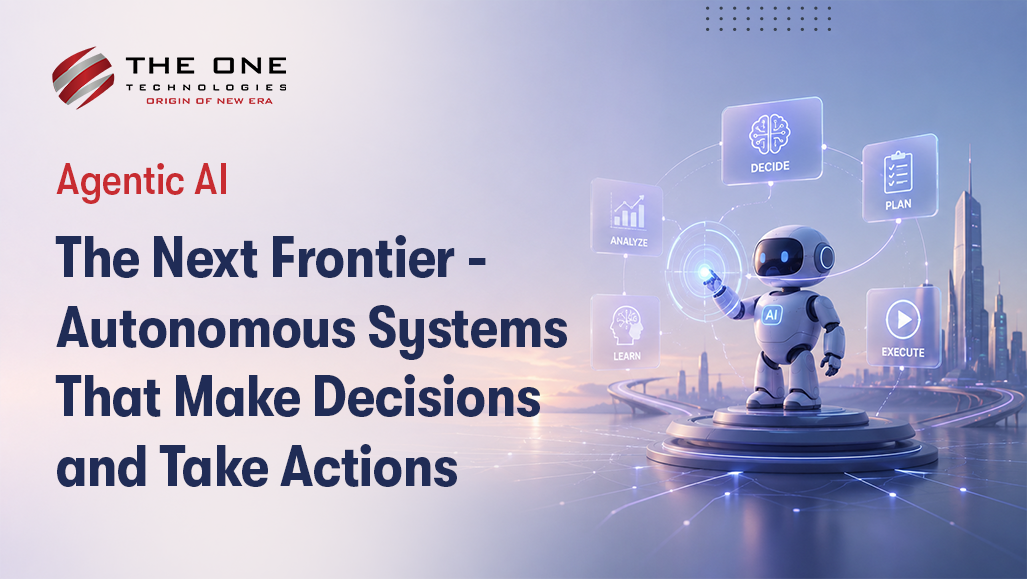
A chatbot answers your question. An agent decides what to do next, then does it.
That's the line agentic AI crosses, and it's why 2026 feels different from the chatbot wave of a few years back. These systems don't just respond. They plan a sequence of steps, pull the data they need, and carry out a decision, often without a person approving every move. The One Technologies' AI services team builds systems like this for companies that are past the chatbot stage and want AI that actually moves work forward.
What actually makes AI agentic
Most AI tools before this wave did one thing. Classify a document, predict a number, generate a paragraph. You asked, it answered, and you decided what to do with the answer.
Agentic AI closes that last gap. Give it a goal, say, cut cart abandonment by 15 percent, and it can pull the data, test a few approaches, adjust send times, and report back. No one has to approve each step along the way.
The building blocks aren't new. Machine learning, natural language processing, computer vision, all of it existed before. What changed is stringing them together with memory and a planning loop, so the system carries context from one action into the next instead of starting fresh every time.

How agentic AI differs from RPA
RPA scripts follow a fixed set of steps. Click here, copy this field, paste it there. Change one input outside its expected range, and the bot breaks.
Agentic AI doesn't run off a fixed script. It has a goal and a set of tools, and it decides which tool to use and in what order, based on what it actually finds. Point it at a messy inbox instead of a clean form, and it can still work out what to do next.
That's also why it takes more engineering to build correctly. A broken RPA bot fails loudly and stops. A poorly built agent can keep running and keep making decisions you didn't intend, which is exactly why the guardrails matter more here than they ever did for RPA.
Where it's already making decisions
This isn't a future-tense conversation. A few places it's already live:
- Inventory systems that reorder stock and adjust pricing based on real-time demand, no purchasing manager in the loop for routine restocks.
- Fraud systems that freeze a suspicious transaction and route it for review the moment it happens, instead of flagging it for someone to check the next morning.
- Support systems that resolve a ticket start to finish, and only escalate the ones that genuinely need a person's judgment.
- Scheduling agents that book, reschedule, and confirm appointments across calendars without anyone touching a single invite.
What goes wrong when you skip the guardrails
Handing decisions to a system that plans its own steps is powerful. It's also where most agentic AI projects go sideways.
An agent with no spending cap can burn through an ad budget in an afternoon. One with no escalation rule can approve the same refund twice. Usually the failure mode is a confident agent running unsupervised, not a wrong answer.
Every agentic system needs a boundary: what it's allowed to decide alone, and what gets flagged for a person first. That boundary is the actual engineering work. The automation part is the easy half.
What a real deployment looks like
Start small. Pick one decision, not ten.
- Define the decision precisely, such as approve refunds under $50 without review.
- Set the escalation rule for anything outside that range.
- Connect the agent to the systems it actually needs, your CRM, your inventory feed, your support desk.
- Watch its first 100 decisions closely before you widen its scope.
Most teams that skip straight to a wide rollout end up walking it back within a month. The ones that start narrow and expand gradually rarely have to.
Where this fits your business right now
Not every process needs an autonomous agent. A rule-based workflow still beats agentic AI for anything predictable and low-stakes. Agentic AI earns its place where the decision is repetitive, time-sensitive, and involves pulling data from more than one place before acting. The right AI development partner builds these systems around a single business goal at a time, using custom algorithms and predictive models trained on your data, not a general-purpose bot that tries to do everything and ends up doing none of it well.
The Conclusion
Agentic AI is software that acts on your data instead of waiting for someone to read a dashboard and decide. That's a different kind of tool, and it deserves a build process that treats the guardrails as seriously as the automation itself.
If you're ready to move past pilots and proofs of concept, hire AI developers at The One Technologies to scope a system built around one decision your business makes every day, and build it to actually run on its own.