
ASP.NET WebForms vs MVC vs .NET Core: Which to Choose? | Blog
TL;DR
Choosing between ASP.NET WebForms, MVC, and .NET Core is less about features and more about long-term business value. WebForms and traditional MVC are suitable only for maintaining existing legacy applications, while modern ASP.NET Core is the preferred choice for new development due to its better performance, security, scalability, lower hosting costs, and larger developer talent pool. If you're planning a new project or modernization initiative, ASP.NET Core is the future-ready option that minimizes technical debt and supports cloud-native development.
Choosing an architecture for your business app is a multi-year commitment. If you are building in the Microsoft ecosystem, you are choosing between three distinct eras of web history-Legacy WebForms, MVC, or modern .NET. Pick the wrong one and you are immediately fighting uphill. You will spend half your budget keeping ancient dependencies on life support, dodging security audits, and trying to convince engineers to work on a stack.
This isn't a feature-by-feature technical debate. It is a business risk calculation. If you are spinning up a new project or looking at an aging legacy system, partnering with an experienced custom .NET development company gives you an honest assessment of where these frameworks actually stand today.
The Reality of ASP.NET WebForms Today
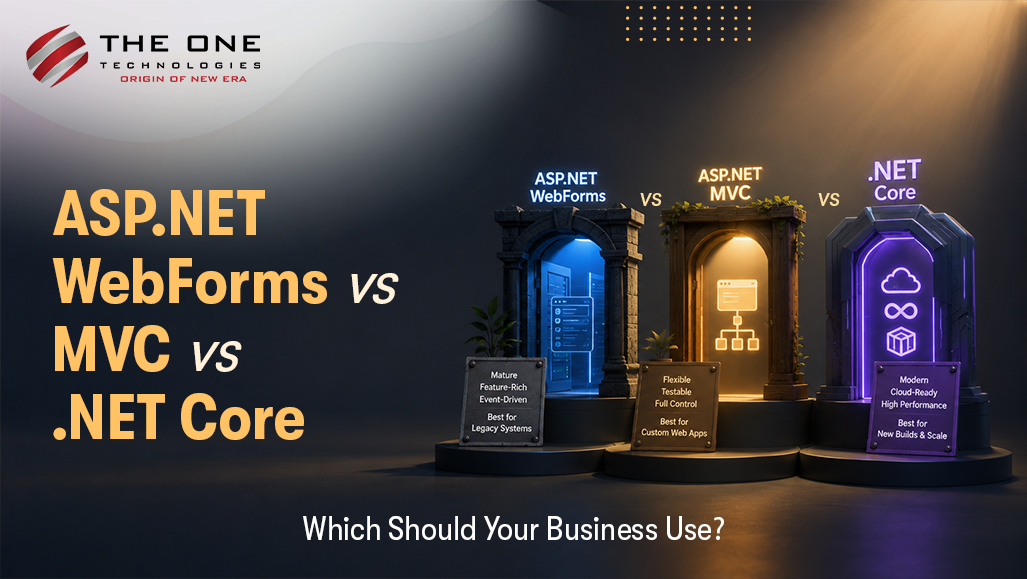
ASP.NET WebForms dates back to the early 2000s. It was designed to help desktop developers build websites without needing to figure out how the web actually worked, relying on drag-and-drop tools and ViewState to manage data. It worked well twenty years ago. Microsoft only releases basic security patches for it-zero new features and zero performance upgrades.
The only practical reason to stick with WebForms is if you are trapped by a massive internal app where a rewrite is completely out of the financial question. If your workflow is just fixing minor bugs or updating an old internal table, leaving it alone makes sense. But trying to build new features on top of it is just burying yourself in technical debt. If your current team doesn't know the framework, you will end up spending a premium on specialized contractors just to keep the lights on.
Where ASP.NET MVC Fits into Modern Infrastructure
ASP.NET MVC was a lifesaver when it dropped in the WebForms era. It finally brought proper MVC architecture to Microsoft developers, delivering clean HTML control and making unit testing a real option instead of a headache. But it has a major limitation today-it is tied to the legacy, Windows-only .NET Framework.
Unless you're maintaining a large .NET Framework application that's too expensive to migrate or your IT department is committed to on-premises Windows infrastructure, there is little reason to choose traditional ASP.NET MVC for new projects. Even if you partner with a custom .NET development company, building a greenfield application on classic MVC limits your future flexibility.

Why .NET Core Is the Standard for New Projects
If you're building a new application or rewriting a legacy one, modern ASP.NET Core is the recommended choice. Microsoft rebuilt the framework to remove Windows-only limitations, allowing applications to run on Linux, Windows, and macOS.
The biggest advantage is long-term sustainability. ASP.NET Core is fast, lightweight, cloud-ready, and works seamlessly with Docker, Kubernetes, Azure, and modern deployment pipelines. Instead of relying on specialists to maintain aging frameworks, businesses can take advantage of the growing ecosystem of .NET Core developers.
It also integrates naturally with modern frontend frameworks like React, Angular, and Vue, making it an ideal backend platform for scalable enterprise applications.
How Framework Selection Impacts Business Costs
The framework you choose directly affects infrastructure costs, maintenance expenses, and hiring decisions.
Older WebForms and MVC applications require Windows Server licensing, increasing hosting costs. ASP.NET Core supports Linux hosting, significantly reducing infrastructure expenses while improving scalability for cloud-native deployments.
Hiring is another major consideration. Finding experienced WebForms or classic MVC developers is becoming increasingly difficult. Most developers prefer modern C#, dependency injection, minimal APIs, and ASP.NET Core. Choosing the latest framework makes recruiting easier while reducing long-term maintenance risks.
Security also plays an important role. ASP.NET Core receives continuous feature improvements, security updates, and built-in identity management, helping organizations reduce security risks without relying on custom implementations.
Conclusion
Deciding on a framework comes down to your current setup and where you're headed. If your current system works fine and rarely needs updates, don't feel pressured to move. Sticking with legacy MVC or WebForms is just practical.
But if you're planning a cloud migration or launching something new, you're going to need .NET Core. Running a business on outdated tech eventually puts you in a corner. You'll struggle to find reasons to hire ASP.NET WebForms developers willing to touch an old codebase, and eventually, the security patches just stop.
If you’re staring down a legacy codebase that needs a rewrite, or you want to map out a new enterprise app from scratch, let's talk. Reach out to us at The One Technologies and we can figure out the most practical path forward for your team.