Continuous Testing in CI/CD: How Teams Catch Bugs Faster
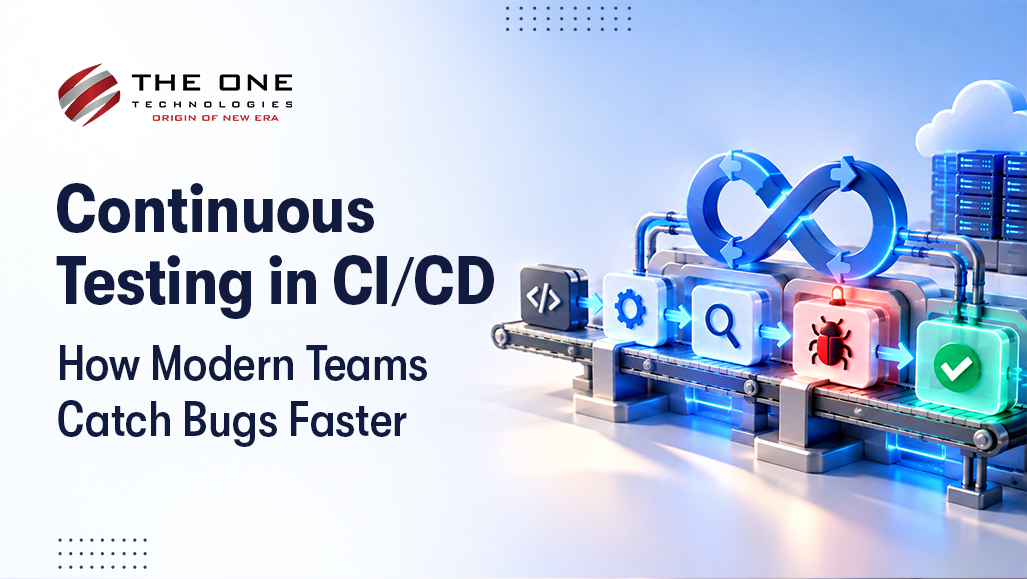
A team shipping multiple times a day is still running a testing strategy built for one release a sprint. That mismatch is where bugs slip through, not because the tests are bad, but because they run too late to matter.
Continuous testing closes that gap by turning quality checks into something that runs on every commit instead of a phase that happens right before release. Teams working with software testing and QA services built around this model catch problems while the code is still fresh in a developer's head, not weeks later during a pre-release scramble.
What continuous testing actually replaces
The old model treated testing as a gate at the end: write the code, hand it to QA, wait for a pass or fail. That worked fine when releases happened monthly. It falls apart completely once a team is deploying several times a day, because nobody has weeks to spare for a manual verification pass anymore.
Continuous testing turns quality into an always-on signal instead. Every commit, every pull request, every deploy gets validated automatically, and feedback comes back in minutes rather than at the end of a sprint.

The testing pyramid, mapped to real pipeline stages
Unit tests run first and fastest, ideally under five minutes, catching broken functions before code goes anywhere near a shared branch. Static analysis runs alongside them, flagging code smells and obvious security issues before a human even opens the pull request.
Integration and contract tests come next, checking that services, APIs, and database calls behave correctly once combined rather than in isolation. Full end-to-end suites, security scans, and load tests run against a staging environment before anything reaches production. Once it's live, testing narrows to non-destructive smoke tests and synthetic monitoring, just enough to confirm the application is actually working without simulating real load against real users.
Quality gates: enforcement, not a judgment call
A quality gate is a pass or fail check on a specific metric, coverage above a set threshold, zero high-severity vulnerabilities, every test passing, no new type errors. If a build fails the gate, the pipeline stops. No human has to review it, and nobody gets to quietly wave it through because a deadline's close.
That automatic enforcement is what separates a continuous testing pipeline from a delivery mechanism that just happens to run some tests along the way. One catches bugs at the cheapest possible stage. The other ships whatever gets pushed to it.
A concrete example of a gate doing its job
A team sets a non-negotiable rule: no response time over 200 milliseconds, no exceptions. A build ships with a database query that quietly regresses that number to 400 milliseconds under load. The performance gate catches it before deployment, and the pipeline stops automatically, before a single real user notices anything slow.
Nobody had to remember to check response times manually. Nobody had to escalate it to a senior engineer for a judgment call. The rule caught the problem because the rule was built into the pipeline instead of living in someone's head.
The finding that surprises most teams
Speed and stability look like a tradeoff on paper. Ship faster, break more things, that's the intuition most engineering leaders start with. Google's DORA research consistently finds the opposite among elite-performing teams: they deploy far more frequently than low performers while also maintaining lower change-failure rates.
That combination only happens when automated testing validates every change continuously, instead of quality getting checked in occasional big batches. Once testing runs on every commit instead of once a sprint, going faster and staying stable stop competing with each other.
Where teams get this wrong
Running a full four-hour test suite on every single commit defeats the entire purpose. Fast feedback needs a staged strategy: smoke tests first, a broader regression pass next, the full suite reserved for pre-deploy. Skip that staging and developers just stop waiting for results, which quietly kills the whole point of testing early.
Flaky tests do similar damage. A test that fails intermittently for reasons unrelated to the actual code teaches a team to ignore failures generally, and once that habit sets in, a genuine bug starts looking exactly like background noise.
What this looks like in a real pipeline
A developer pushes a commit. Unit tests and static analysis run in under three minutes and catch a broken function before the pull request even opens for review. Once merged, integration tests confirm the new code plays correctly with the existing API layer. A staging deploy runs the full suite overnight, and only a build that clears every gate reaches production the next morning.
Nobody manually verified any of that. The pipeline did, automatically, at every stage. If your team is still shipping fast but testing slow, The One Technologies can help you build a pipeline where the two stop working against each other.