
How to Refine Raw Data: The Role of Data Lakes, ETL, and SQL Server
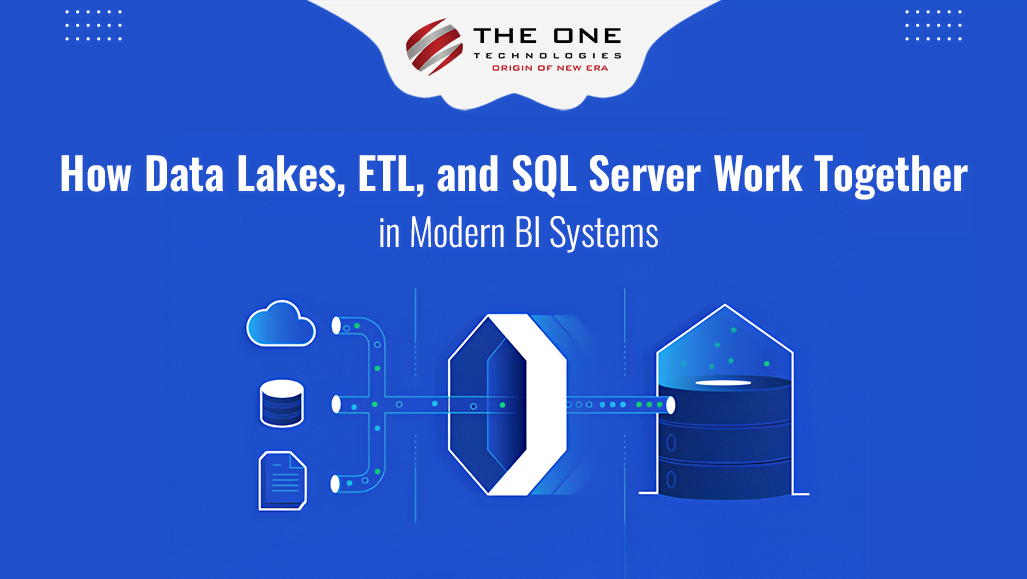
If you think of raw data as crude oil, then the BI architecture is the oil refinery. Modern organizations receive massive amounts of data. Often in the form of information from websites, applications, and internal data sources. Yet, this data is useless unless it is refined. The purpose of the oil refinery is to clean, separate, and process the oil to make it useful. In the digital world, the trusty trio that helps us refine our data consists of data lakes, ETL pipelines, and SQL server databases. As an IT Consulting Company, we follow these practices to help businesses transform raw data into meaningful and actionable insights.
The combination of these technologies working well together will provide organizations with a robust data ecosystem. One that supports precise reporting, analytics, and decision-making. This article from will explore the way that data lakes, ETL processes, and SQL Server come together as part of today’s BI solutions. And why this architecture is quickly becoming the de facto standard for organizations of all kinds.
The Role of Data Lakes in Modern Data Architecture
The "data lake" serves as the central repository for large volumes of unrefined and structured data. A data lake is different from a traditional database. In that it allows data to be dumped in exactly the same form it was collected in. Whether it is completely structured, somewhat structured, or completely unstructured.
It is this very nature of data lakes that allows them to be used to incorporate data from a variety of sources. Such as application logs, APIs, CRM systems, and IoT devices, and not necessarily process it immediately. And determine later how it should be processed or analyzed, which is called schema-on-read.
At the core of most BI architectures in today’s environment, data lakes have become the primary intake and storage facility. They are scalable and cost-effective, thus providing a single hub for the entire enterprise data. However, data in its raw form cannot, in itself, power reporting and analytics. That is where ETL comes in.
ETL: Transforming Raw Data into Usable Insights
Extract, Transform, and Load, or ETL, is the process that moves data from many different locations into a clean and ready state for analysis. In the extract phase, data is retrieved from various locations. Including web applications, software applications, databases, and cloud-based data. Once that is done, the data is moved to the transform phase, where the data is cleaned up, standardized, and enriched. In this phase, data may be de-duplicated, have formatting issues corrected, or even combined.
Once this data is processed, it is imported into a structured database or data warehouse. This final step ensures that data is properly organized for BI tools and reporting systems to readily access it.
In today’s architecture, data is typically fed into ETL systems from a data lake. These systems will apply transformation rules to properly clean and enhance this data. Once this is done, the data sets will be loaded into a database such as SQL Server.

Why SQL Server Remains a Powerful BI Foundation
SQL Server is at the heart of the BI stack as the "go to" solution for analytics. Data lakes are good for storage. ETL pipelines are good for preparing the data. But it's SQL Server that structures the transformed data into a robust relational environment. Tables, views, and well-designed structures become the foundation for reporting. And the robust query processor along with good indexing provides fast access to large volumes of data.
Another bonus is that it works very well with the major BI and analytics applications that most people are familiar with and are using today. Tools like Power BI, various reporting dashboard applications, and enterprise applications can seamlessly connect to SQL Server databases. To generate reports, build visualizations, and track performance metrics.
SQL Server provides a complete range of sophisticated tools to manage data. Including stored procedures, intelligent indexing, partitioning, and robust security features. These ensure that business information is readily accessible, fast, and secure. In modern BI infrastructures, SQL Server is commonly used as the curated data layer. Where analyzed and structured information is kept for daily use.
How Data Lakes, ETL, and SQL Server Work Together
A robust BI implementation integrates these three pieces of the puzzle into one cohesive process. Most often, this process begins with data ingestion, where raw data is gathered from various sources and dumped into a data lake. The next process is the application of ETL, where required information is extracted from the lake. Transformed according to business rules, and made ready for storage.
Once the transformation is done, the data gets loaded into SQL Server databases. Which are then structured in an efficient format such as a star or snowflake structure. This makes it easier for reporting tools to access the data. Finally, the BI tools and dashboards connect to SQL Server. Which enables the creation of reports, the tracking of KPIs, and the creation of insights that guide business decisions.
This layered architecture provides both flexibility and performance. Data lakes offer scalable storage, ETL pipelines ensure data quality and consistency. And SQL Server delivers fast and reliable analytics.
Benefits of This Modern BI Architecture
- Better scalability for large data volumes
- Improved data quality and governance
- Faster analytics and reporting performance
- Support for future initiatives like machine learning
The Conclusion
What modern BI systems require is not just the collection of data. A strong system needs a process that is flexible, scalable, and efficient. Mixing data lakes, ETL tools, and SQL Server databases will create a strong and efficient system.
This will ensure that unprocessed data is collected properly. Transformed into meaningful data sets, and delivered to reporting tools in a timely and accurate manner. With more organizations depending on data-driven business strategies? This mix of technologies is one of the most powerful ways to take your BI systems to the next level.
If your organization is interested in developing or improving a state-of-the-art BI solution architecture? The experts at The One Technologies can assist your business. Contact us today to begin creating scalable data pipelines and analytics systems that meet your business needs.