
Google Ends FAQ Rich Results in 2026: What Website Owners Need to Know
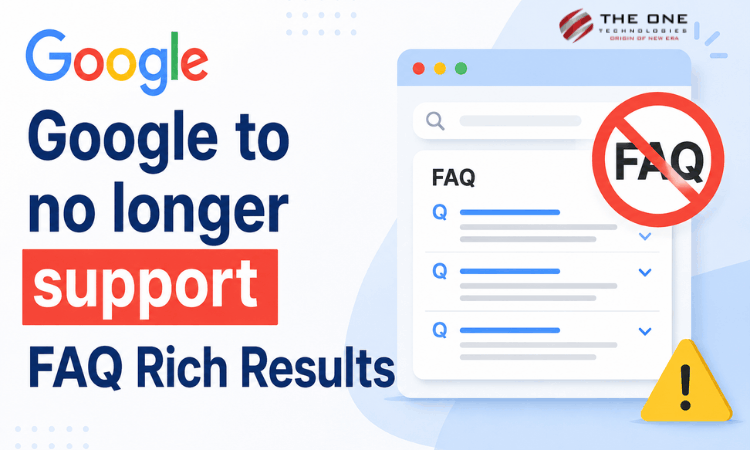
Google has officially pulled the plug on FAQ rich results.
As of May 7, 2026, FAQ rich results no longer appear in Google Search.
If your pages used FAQ schema to earn those expandable question-and-answer listings, they are gone.
That’s the headline.
And for many Digital Marketing professionals, it marks the end of a tactic that once delivered a noticeable bump in click-through rates.
Google also confirmed that the related reports in Search Console will disappear soon.
So if your SEO dashboard suddenly looks different, this is why.
Google announced the change in its official developer documentation.
What exactly changed?
For years, websites could add FAQ structured data to pages.
When Google liked the markup, it sometimes displayed the questions and answers directly in the search results.
Users could expand those questions without visiting the page.
It looked like this:
- What is SEO?
- How long does SEO take?
- How much does SEO cost?
Each question opened to reveal a short answer.
These results took up more space on the search page.
That extra real estate often helped pages attract more clicks.
Now Google has stopped showing them entirely.
The documentation now states:
FAQ rich results are no longer appearing in Google Search.
That sentence is short, but the impact is clear.
Timeline for Google's FAQ rich result removal
Google didn’t remove everything at once.
Here’s the schedule.
May 7, 2026
FAQ rich results stopped appearing in Google Search.
June 2026
The FAQ rich result report will be removed from:
- Google Search Console
- Rich Results Test
August 2026
Support for FAQ rich result data will be removed from the Search Console API.
This gives developers a few months to update dashboards and automated reports.
Why Google removed FAQ rich results
Google hasn’t shared a long explanation.
But if you’ve watched search results over the last few years, this move isn’t surprising.
Back in 2023, Google heavily restricted FAQ rich results.
They were mostly shown only for highly authoritative government and health websites.
Most commercial websites lost visibility at that time.
For many businesses, FAQ schema was still present in the code, but it no longer produced visible results.
The May 2026 update simply makes that situation official.
Google is cleaning up a feature it had already phased out.
What are FAQ rich results?
FAQ rich results were enhanced search listings generated from structured data.
You added code to your page using the FAQPage schema type from Schema.org.
Google then read that markup and sometimes displayed the questions and answers directly in search.
The content had to match what users could see on the page.
If your answers were hidden or misleading, Google ignored the markup.
Why website owners used FAQ schema
FAQ schema became popular for one reason.
It often improved visibility.
A search listing with expandable questions stood out.
It occupied more space.
And it answered common concerns before the click.
For example, a service page targeting “software testing services” could show:
- What is software testing?
- How much does software testing cost?
- How long does QA take?
That made the listing look more useful than a plain blue link.
For some sites, click-through rates improved noticeably.
Will this hurt SEO rankings?
No, at least not directly.
Google is removing a search appearance feature.
It is not penalizing websites that use FAQ schema.
Your rankings should stay the same.
What may change is click-through rate.
If your listing previously appeared with FAQ rich results, users now see a standard result.
That can reduce visual prominence.
Whether traffic drops depends on how much those rich results contributed to your clicks.
How to check if your site is affected
Open Google Search Console.
Look at historical performance data.
Compare:
- Impressions
- Clicks
- Click-through rate
Focus on pages that contained FAQ markup.
If you notice a drop beginning in May 2026, the removal may be one factor.
But keep context in mind.
Traffic changes often have multiple causes.
Seasonality, ranking shifts, and search demand also matter.
Should you remove FAQ schema?
You have two options.
Option 1: Leave it in place
This is perfectly fine.
Google said you can keep the code.
Other search engines may still use it.
Structured data can also help internal systems and future integrations.
If removing it takes time, there is no urgent reason to act.
Option 2: Remove it
If your team wants cleaner code, you can delete FAQ structured data.
This reduces maintenance.
It also prevents confusion for developers who expect visible results in Google.
Both options are valid.
If the FAQ content is still useful to readers, keep it on the page.
The structured data itself is now optional.
Should you keep FAQ sections on your pages?
Yes.
The visible FAQ content still has real value.
People ask questions before they buy.
A good FAQ section can:
- Address objections
- Explain pricing
- Clarify timelines
- Build trust
That matters for conversions.
And it helps your page cover natural search terms.
So even though Google no longer displays FAQ rich results, the content itself still earns its place.
What happens to Search Console reports?
The FAQ enhancement report will disappear in June 2026.
If your reporting process relies on that data, plan to update your dashboards.
The Search Console API support ends in August 2026.
Any automated scripts pulling FAQ-specific metrics will need changes.
For most marketers, this won’t be a major issue.
But developers with custom reporting should schedule the update now.
What about other schema types?
This change affects FAQ rich results only.
Other structured data types remain active, including:
- Product
- Review
- Article
- BreadcrumbList
- Organization
- LocalBusiness
These still help Google understand page content.
And many continue to generate rich results.
So structured data still matters.
Just don’t expect FAQ markup to influence your Google listings.
How this affects SEO agencies
If you run an SEO agency, this is a good time to review your deliverables.
Many agencies still list FAQ schema implementation as a core service.
You can still provide it if the FAQ content improves user experience.
But you should stop positioning it as a tactic for winning Google FAQ rich results.
Clients appreciate transparency.
Tell them exactly what changed.
Explain that the content still helps visitors, even if Google no longer shows the enhanced listing.
How this affects ecommerce sites
Ecommerce brands often used FAQ schema on:
- Product pages
- Category pages
- Shipping pages
The visible FAQ content remains useful.
Questions about returns, delivery, sizing, and warranties reduce friction.
That can improve conversions.
So keep the FAQ content if customers rely on it.
The loss is purely in search presentation.
How this affects local businesses
Local businesses used FAQ schema for service pages targeting cities and neighborhoods.
For example:
- How much does house cleaning cost in Pune?
- Do you provide same-day service?
- What areas do you serve?
These FAQs still help potential customers.
And they can strengthen page relevance for long-tail queries.
You just won’t see the questions expand directly in Google Search anymore.
What SEO professionals should do now
Here’s a sensible checklist.
1. Audit pages with FAQ schema
Identify which URLs use FAQPage markup.
2. Measure traffic trends
Compare data before and after May 7, 2026.
3. Decide whether to keep or remove markup
Base the decision on development priorities.
4. Keep useful FAQ content
If it helps visitors, leave it.
5. Update client reports
Remove FAQ rich result expectations from deliverables.
6. Adjust automated API calls
Prepare for Search Console API changes in August 2026.
My take on this update
This change is more administrative than dramatic.
Most websites lost FAQ rich result visibility years ago.
May 2026 simply closes the chapter.
If you still have FAQ schema on your site, you don’t need to panic.
Your rankings won’t collapse.
Your pages won’t be penalized.
The visible FAQ content still helps users.
And that’s what matters most.
Focus on what still works
SEO has always evolved.
Tactics come and go.
What lasts is useful content that answers real questions.
If your page solves a problem clearly, it still has a strong chance to perform well.
Structured data remains useful where Google supports it.
But FAQ rich results are no longer part of the equation.
Final thoughts
Google has officially retired FAQ rich results.
Search Console reports will disappear next.
And the API support will follow in August 2026.
For site owners, the practical response is simple:
- Keep FAQ content if it helps users.
- Remove schema only if you want cleaner code.
- Monitor traffic and click-through rates.
- Update SEO reporting expectations.
That’s it.
One feature is gone.
Good content still works.
Author Bio
 Madan Kumar is a Digital Marketing Team Leader with over 7 years of experience in crafting data-driven strategies that boost brand visibility and drive business growth. With a passion for PPC, link building, and social media marketing, he thrives on turning clicks into conversions and strategies into success stories.