How to Hire Bubble Developers for AI-Powered Web Apps
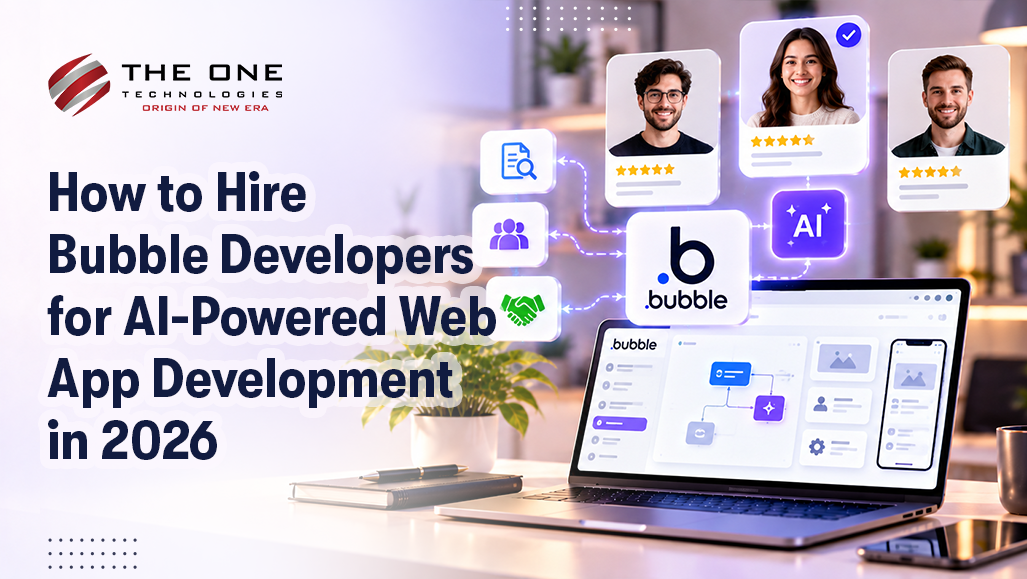
Bubble's own AI builder can now generate a working app, database, authentication, and workflows included, in about 5 to 7 minutes from a text prompt. That's genuinely impressive. It's also not the same thing as a production-ready application.
That gap between a fast demo and something real users can rely on is exactly why demand to hire Bubble developers has grown alongside the AI tooling, not shrunk because of it. The AI got better at scaffolding. What happens after the scaffolding still takes someone who knows the platform under real load.
What 'AI-powered' actually means on Bubble now
The AI app generator handles the first draft: database structure, basic workflows, a working interface. Bubble added a native mobile app builder in August 2025, so that first draft can target iOS and Android alongside the web version without a separate build.
Layered on top of that, the API connector lets a Bubble app call out to OpenAI, Anthropic, or other model providers directly, so the application genuinely embeds AI features, a support assistant, a content generator, a recommendation engine, into the product itself, not just a faster build process.

Why a fast AI-generated MVP still needs a developer
Generating an app is the easy ten percent. Data privacy rules, workflow logic that holds up under concurrent users, database relationships that don't fall apart as the record count grows, these are the parts an AI generator sketches but doesn't fully solve.
A five-minute MVP is a real starting point. It's rarely a finished product, and treating it like one is where a lot of first-time Bubble builds run into trouble a few months after launch.
The AI-specific risks most no-code guides skip over
Wiring an AI model into a Bubble app is straightforward for a proof of concept. Shipping it to real users with sensitive data involved is a different problem entirely, and it's architecture, not plugins, that closes the gap.
Access control is the first issue. Hiding a field in the interface doesn't protect it if the underlying API stays open, which is one of the most common security gaps in web applications generally. The second is prompt injection: any content a model reads, including something a user uploads, can carry instructions the model wasn't supposed to follow. The third is reliability. Independent testing from May 2026 found that even well-grounded AI summaries still introduce information absent from the source roughly 2 to 6 percent of the time. Building AI features with someone who's accounted for all three matters more than avoiding AI features altogether.
What a Bubble AI developer actually adds
Experienced Bubble app developers bring the parts a generator can't: database architecture that scales past a few hundred users, workflow logic for edge cases nobody thought to prompt for, and AI integrations built with access control and error handling from the start instead of bolted on after something breaks.
That's the difference between a working demo and a product a business can actually run on. The visual editor makes the platform approachable. It doesn't make production engineering optional.
Where Bubble genuinely fits, and where it doesn't
Bubble is a strong fit for an MVP, an internal tool, or a product validating demand with a modest user base. It's worth knowing upfront that Bubble doesn't export source code, so an application that outgrows the platform faces a real migration cost later, not a small one.
That tradeoff is worth making with eyes open rather than discovering it two years and thousands of users in. A developer who's shipped production Bubble apps before can tell you honestly whether a given project fits that tradeoff or not, before the build starts rather than after.
What hiring the right fit looks like
A team wants an internal tool with an AI-assisted intake form built in weeks, not months. A Bubble developer scopes the data structure first, wires the AI model through a properly access-controlled endpoint, and builds the workflow logic to handle a rejected upload or a malformed response instead of assuming every input arrives clean.
The AI wrote the first draft. The engineering discipline is what makes it hold up in production. If you're scoping a build that needs both speed and that discipline, Bubble AI developers at The One Technologies can take it from prompt to production.