
What Is Model Context Protocol (MCP) and Why It Matters
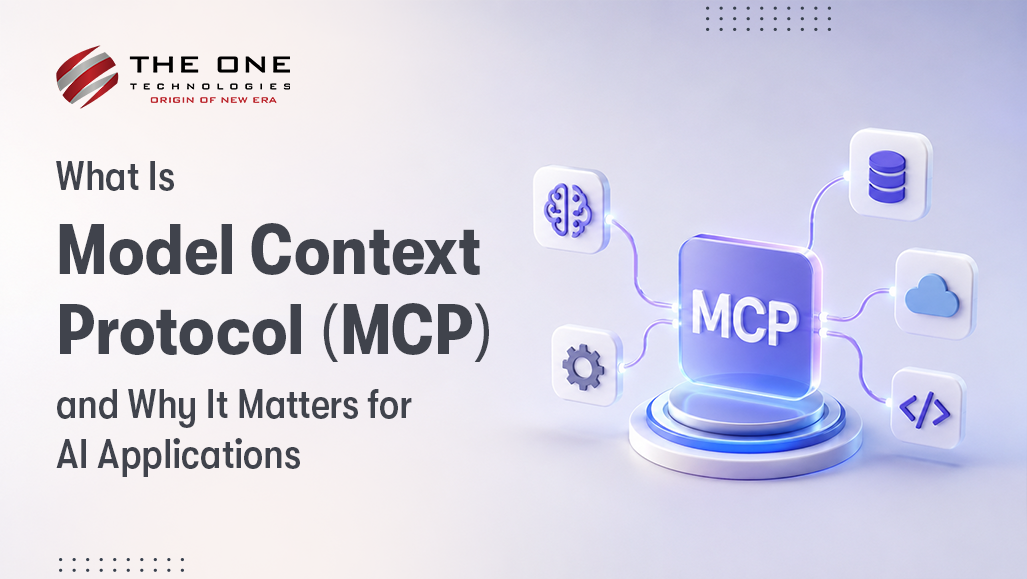
Before November 2024, connecting an AI model to your CRM, your database, and your internal wiki meant writing three separate, custom integrations. Connect it to five tools, and maintaining five one-off pieces of code that all break differently.
Model Context Protocol replaced that with one open standard. Anthropic released it as open source, and in under two years it's picked up 97 million monthly SDK downloads and running in production at 28 percent of Fortune 500 companies. Teams building custom AI services now treat it as a default building block rather than an optional add-on.
What MCP standardizes
Think of it as a common plug instead of a different cable for every device. Before MCP, every AI application needed its own custom code to talk to every tool it used. An assistant that pulled from Salesforce, Notion, and a Postgres database needed three separate integrations. Each with its own quirks, and each one broke independently when the underlying API changed.
MCP defines one protocol for that connection. Build an MCP server once for your database, and any MCP-compatible AI application can use it. Whether that application comes from Anthropic, OpenAI, Google, or a startup nobody's heard of yet. The integration gets built once instead of once per AI tool that wants to use it.

The problem it solves
Developers call this the N times M problem. N AI applications, each needing to connect to M different tools, means N times M custom integrations if everyone builds their own. Ten applications and twenty tools is 200 separate integrations, most of them doing nearly identical work in incompatible ways.
MCP turns that into N plus M. Build the tool's MCP server once, build the application's MCP client once, and every combination just works. That's the entire reason the ecosystem grew as fast as it did. The math got dramatically better for everyone building on it.
What this looks like in practice
Picture a support agent that needs to check an order status, look up a customer's account history, and file a return. Without MCP, that's three custom integrations, each maintained separately, each breaking on its own schedule when one of those systems ships an API update.
With MCP, each of those systems exposes an MCP server once. Order status, account lookup, return filing, all speak the same protocol. Swap the underlying AI model six months from now, and none of those three integrations need to be rebuilt. That portability is the actual point, not a side benefit.
What adoption looks like right now
The numbers move fast enough that any snapshot goes stale within months, but the direction is consistent. Over 10,000 MCP servers are published to public registries. The protocol moved to the Linux Foundation's Agentic AI Foundation in December 2025 for vendor-neutral governance, which matters because no single company controls where the standard goes next.
Real deployments back up the interest. Block cut token usage by 98.7 percent company-wide after adopting MCP through its internal Goose agent. Raiffeisen Bank reported a 40 percent improvement in risk assessment after integrating MCP into its risk management systems. PayPal runs MCP in production for payment processing and fraud detection, not a pilot tucked away in an innovation lab.
What still needs work
Production maturity hasn't caught up to the download numbers. A December 2025 survey of 300 senior technical leaders found only 41 percent had MCP servers in limited or broad production, well behind the hype suggesting near-universal deployment.
Security is the clearest gap. MCP's specification calls for OAuth 2.1 authentication, but only about 8.5 percent of live servers actually implement it. Teams are also running into what's being called MCP shadow IT: employees standing up unauthorized MCP servers inside a company's infrastructure, outside whatever review process IT thinks is in place. A protocol built for opening connections needs just as much attention paid to closing the wrong ones.
What this means for building AI applications now
If you're building anything that needs an AI model to reach outside its own context, a document store, a CRM, an internal API, MCP is very likely the right layer to build that connection through, instead of a bespoke integration that only works for one model provider.
The tooling is mature enough to build on. The security practices around it are still catching up, which means the implementation details matter as much as the decision to use MCP at all. If you're scoping an AI application that needs to connect to real systems, not just answer questions in a vacuum, hire AI developers who've already worked through where the protocol is solid and where it still needs a second look.