
RAG vs Fine-Tuning: Which AI Approach Is Better?
An LLM's knowledge freezes the day training ends. Your company's data doesn't stop moving that same day. That gap is the entire reason this question exists.
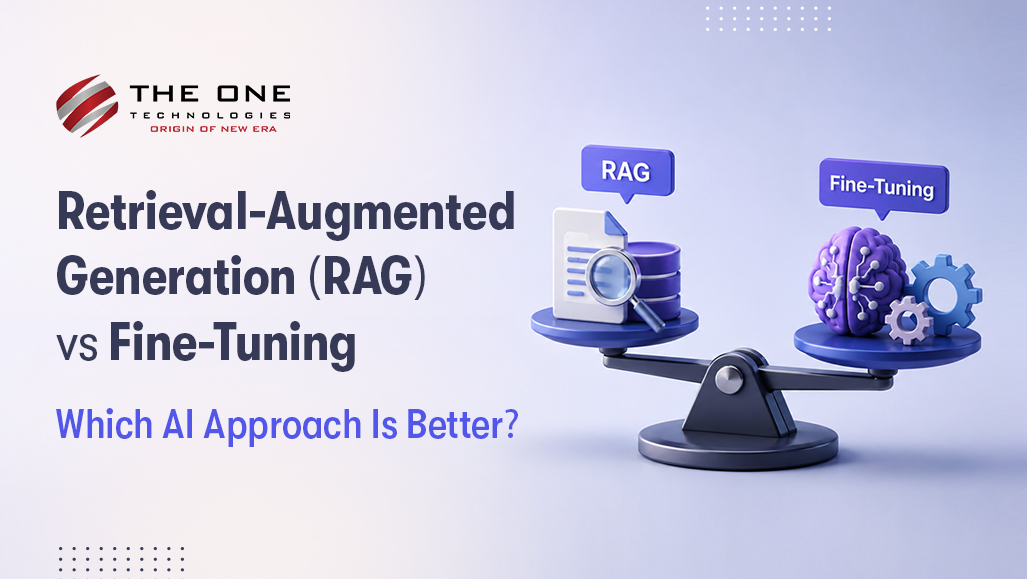
Two ways to close it dominate the conversation. Retrieval-augmented generation, RAG, hands the model your current documents at the moment it answers. Fine-tuning bakes knowledge and behavior directly into the model's weights ahead of time. Over 70 percent of enterprise AI teams now lean on RAG as their primary technique, while fewer than a quarter rely on standalone fine-tuning, and the reason shows up the moment you look at cost and freshness side by side. Teams working with AI services providers usually end up choosing based on one question: does the answer change next week, or does it stay the same for years?
What each one actually does
RAG searches a knowledge base at the moment someone asks a question, pulls the most relevant documents, and hands them to the model alongside the query. The model reasons over what it was just given instead of relying purely on what it memorized during training.
Fine-tuning takes a base model and retrains it on a curated dataset, adjusting the weights so the behavior, vocabulary, and knowledge get baked in permanently. No retrieval step at inference time. The model just already knows, or thinks it does.

Where the accuracy numbers land
A well-tuned RAG pipeline hits 85 to 90 percent answer accuracy on domain-specific knowledge bases, according to a 2024 Applied AI Institute study. Get the chunking and retrieval sloppy, though, and that number can fall to 10 to 40 percent. Implementation quality drives that swing far more than the underlying technique does.
Fine-tuned models tend to hallucinate more on facts they didn't see clearly during training, since they're recalling from parameters rather than reading a source document in front of them. Where fine-tuning pulls ahead is consistency: structured output, a specific tone, a rigid format the business needs every single time. RAG can't guarantee that as reliably.
The cost looks nothing alike
A production RAG system serving 10,000 queries a day against a 500,000-document knowledge base typically runs $4,000 to $9,000 a month, covering vector database hosting, embedding refreshes, and inference. Per query, that lands around half a cent.
Fine-tuning flips the cost curve. A LoRA fine-tune on a 13-billion parameter model with 50,000 examples costs roughly $400 to $1,200 per training run, a one-time hit rather than a recurring bill. Full fine-tuning on a much larger model can climb past $35,000 for a single run. Cheap per query afterward, expensive to get there, and expensive again every time the underlying knowledge needs updating.
When RAG is the right call
Pick RAG when the answer changes: pricing, policy documents, inventory, anything tied to a date. Regulated industries lean toward it too, since a retrieved document is traceable back to its source, which matters when a compliance team asks where an answer came from. A fine-tuned model's weights can't produce that kind of audit trail.
When fine-tuning earns its cost
Fine-tuning wins when the task is narrow, repetitive, and needs a specific structure every time. Extracting the same five fields from thousands of invoices. Classifying support tickets into a fixed set of categories. Matching a company's exact tone across every generated response. None of that benefits much from pulling in fresh documents, since the underlying pattern rarely changes.
What this looks like in practice
Banking and insurance deployments show the split clearly. RAG handles compliance research and customer-facing summaries, where the answer has to trace back to a specific policy document. Fine-tuning handles fraud risk classification and sentiment scoring on earnings calls, where the task is the same shape every single time and speed matters more than citing a source.
Neither technique replaced the other in that setup. They ended up running side by side, each handling the half of the problem it's actually built for.
The pattern most teams land on
Pure RAG or pure fine-tuning is increasingly the exception rather than the default. The pattern that's become standard in 2026 fine-tunes a smaller open model for behavior, vocabulary, and format, then sits it behind a RAG pipeline for the facts. Fast inference, a consistent voice, and answers a compliance team can actually trace back to a source, at the cost of maintaining two systems instead of one.
Getting that split right, what belongs in the model versus what belongs in the retrieval layer, is where most in-house teams underestimate the engineering work. If you're weighing this decision for your own systems, hire AI developers who've built both, and can tell you honestly which one your actual use case needs first.